Is it better to master one martial art or study several?
It’s a question that can spark a lively debate among martial artists. Some believe you should devote yourself entirely to one discipline, while others argue that learning multiple arts makes you a more complete fighter.
I think martial arts cross training works best when it builds on a strong foundation. The real question isn’t whether you should study one art or many, but how to develop mastery while remaining open to what other traditions can teach us.
Mastery Begins with a Strong Foundation
There’s a big difference between knowing a technique and truly understanding it. When we first learn something like Ichimonji no Kata, we’re concentrating on the basics. Where do our feet go? How should we position our hands? Are we moving at the correct angle?
After years of practice, those same movements reveal new lessons. We begin to appreciate the subtleties of distance, timing, balance, and how small changes in positioning affect our training partner.
This is why the Bujinkan places such importance on kihon, or fundamentals. The Sanshin no Kata and Kihon Happo aren’t simply introductory exercises to check off as we advance in rank. We return to them throughout our training, discovering more as our understanding develops.
In The Way of the Ninja, Hatsumi Soke describes how traditional ninja studied a broad range of martial disciplines and knowledge, continuing their education:
“…until they reached a level far beyond mere technical prowess.”
That’s an important distinction. Mastery isn’t about collecting techniques or memorizing kata, it’s about understanding the principles behind the movement, which takes time, repetition, and a willingness to work through the challenges.
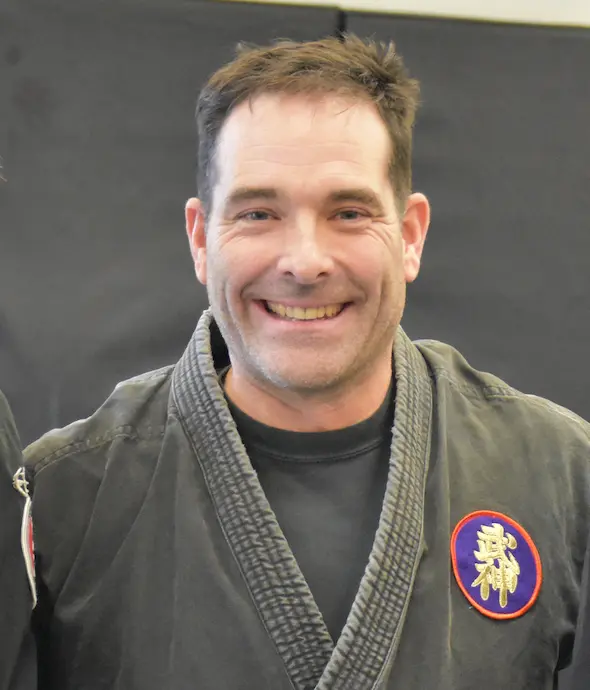
Perhaps one of the most important lessons is that mastery never really ends. Even highly accomplished martial artists continue to seek out their teachers, refine their movement, and discover things they hadn’t understood before. Sensei Mark Roemke’s trips to the Bujinkan Hombu dojo in Japan show that despite his decades of experience, he continues to approach training with the humility of a student.
Without that commitment to developing a strong foundation, studying multiple arts can become little more than collecting techniques without truly understanding how to apply them.
How Martial Arts Cross Training Deepens Understanding
Sensei Roemke has said something that has always stuck with me:
“If you want to understand how to fight a boxer, learn boxing.”
A trained boxer doesn’t just throw punches, they understand combinations, head movement, footwork, distance, and timing. They know how to create openings and recognize opportunities that someone unfamiliar with boxing might miss. You can watch a boxer all day, but stepping into a boxing gym and experiencing those movements firsthand gives you an entirely different perspective.
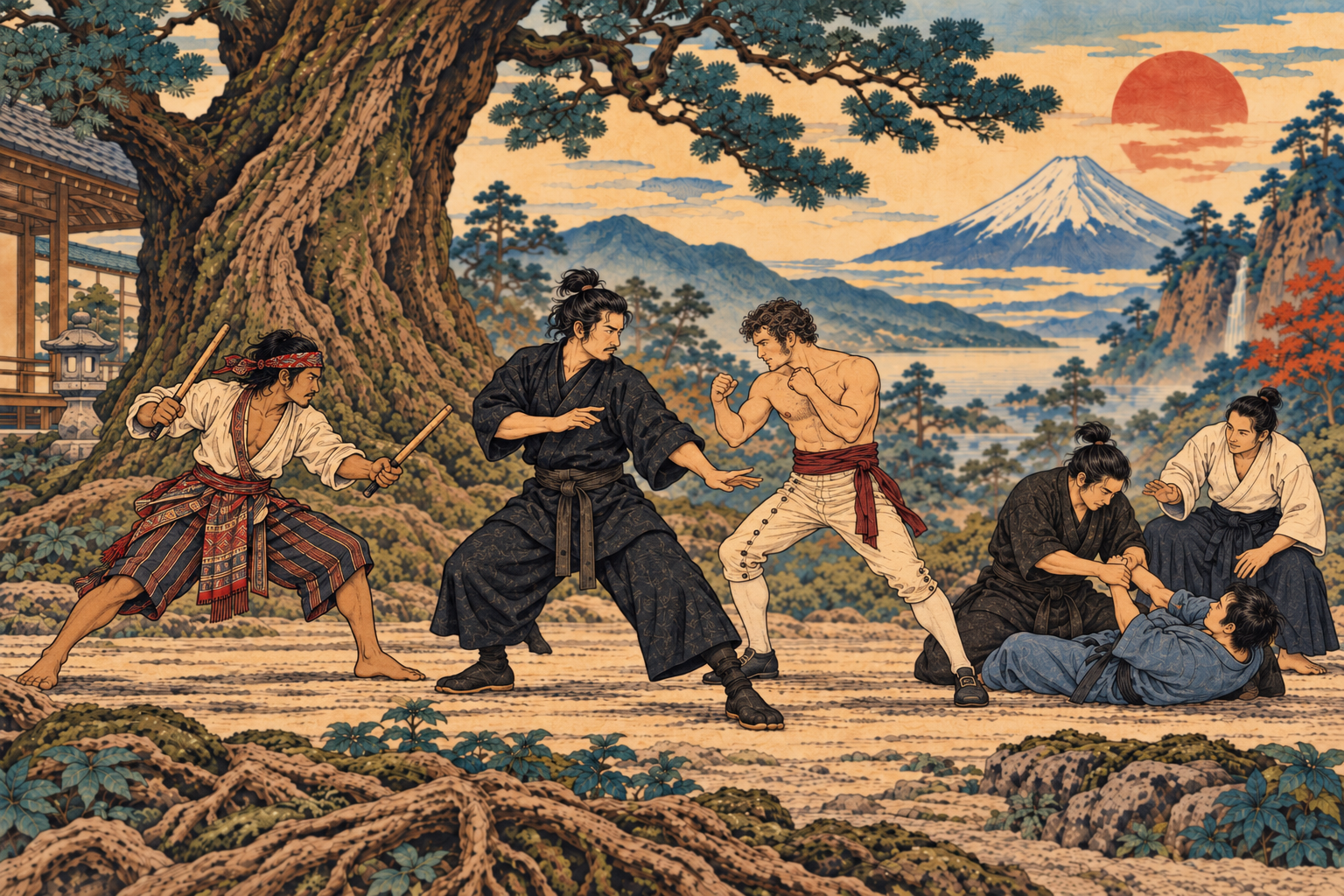
The same applies to other martial arts. Wrestling teaches us about takedowns and controlling an opponent’s body. Judo develops an understanding of balance and throwing. Brazilian jiu-jitsu offers insights into ground positioning and submissions. Eskrima provides a different perspective on weapons, angles, and combinations.
You don’t need to become an expert in every discipline. But understanding how other practitioners move, attack, and defend can make you a more knowledgeable and adaptable martial artist.
Sensei Roemke is an excellent example. Beyond his decades of Bujinkan training, he has studied DeCuerdas Eskrima, Enshin Itto Ryu Battojutsu, and several other martial arts. He was also a Tae Kwon Do champion. These experiences haven’t replaced his Bujinkan training. They’ve given him additional perspectives that inform his understanding of movement and conflict.
In this video, Sensei demonstrates a practical example of how another art can provide a fresh perspective on familiar principles, particularly angles, distance, and positioning.
Understanding the Nature of Violence
There’s another reason to look beyond our familiar training environments.
I’ve had the opportunity to take seminars with Rory Miller, a former corrections officer and author who has spent considerable time studying the nature of violence. Miller distinguishes between two broad categories: social violence and asocial, or predatory, violence.
Social violence often involves status, territory, dominance, and group dynamics. Predatory violence is different. Someone may use violence to obtain a resource, such as money, or because causing harm provides some form of gratification. This distinction matters when we consider how martial arts prepare us for conflict.
Combat sports such as boxing, judo, and MMA develop tremendous fighting skills. Athletes train against resisting opponents, building speed, timing, conditioning, and the ability to perform under pressure. However, sporting competition takes place within an agreed framework. There are rules, referees, and a shared understanding of what constitutes victory.
Predatory violence operates under no such agreement. There may be no warning, no opportunity to prepare, and no interest in a fair contest. The attacker’s goal may have nothing to do with proving who is the better fighter.
The danger isn’t that sport techniques are ineffective. Many are exceptionally effective. The danger is assuming that every violent encounter will follow the patterns we’ve become accustomed to in training. Different martial arts and training methods can expose assumptions we didn’t even realize we were making. Understanding those differences helps us prepare for a wider range of possibilities, while recognizing that no training can guarantee an outcome.
Different Arts, Common Principles
One of the most interesting things about studying different martial arts is discovering how much they have in common.
The techniques may look different. Stances, terminology, strategies, and training methods can vary considerably. But beneath those differences, many of the same principles appear again and again.
Distance. Timing. Balance. Body alignment. Angling. Movement.
A judoka breaking an opponent’s balance and a Bujinkan practitioner applying kuzushi (unbalancing) may approach the problem differently, but both are exploring ways to disrupt another person’s structure. A boxer slipping a punch and a Bujinkan practitioner using tai sabaki (body evasion) may move differently, but both are concerned with positioning themselves relative to an incoming attack. Even weapons training reveals these connections. Whether studying a sword, staff, or escrima stick, we must understand distance, timing, angles, and how a weapon changes the space around us.
Of course, the differences matter too. What works well in one context may need to change considerably in another. Every martial art has its strengths and limitations, and recognizing both makes us better practitioners.
The more deeply we understand our own art, the easier it becomes to recognize these similarities and differences. Ultimately, mastery and cross-training aren’t competing ideas. Mastery gives us the foundation to understand what we’re learning. Exploring other martial arts broadens our perspective, challenges our assumptions, and helps us see familiar principles in new situations.
We don’t need to abandon our art to appreciate another. And we certainly don’t need to become masters of everything.
Put down deep roots. Then look around.