Solo practice, Jūnan Taisō, Sanshin, weapons, and training between classes
Park training was canceled today. Naturally, I was disappointed. Training with Sensei and other students gives us things solo practice cannot: real distance, timing, balance, resistance, and correction. But Sensei isn’t always available.
So does that mean training stops? Of course not.
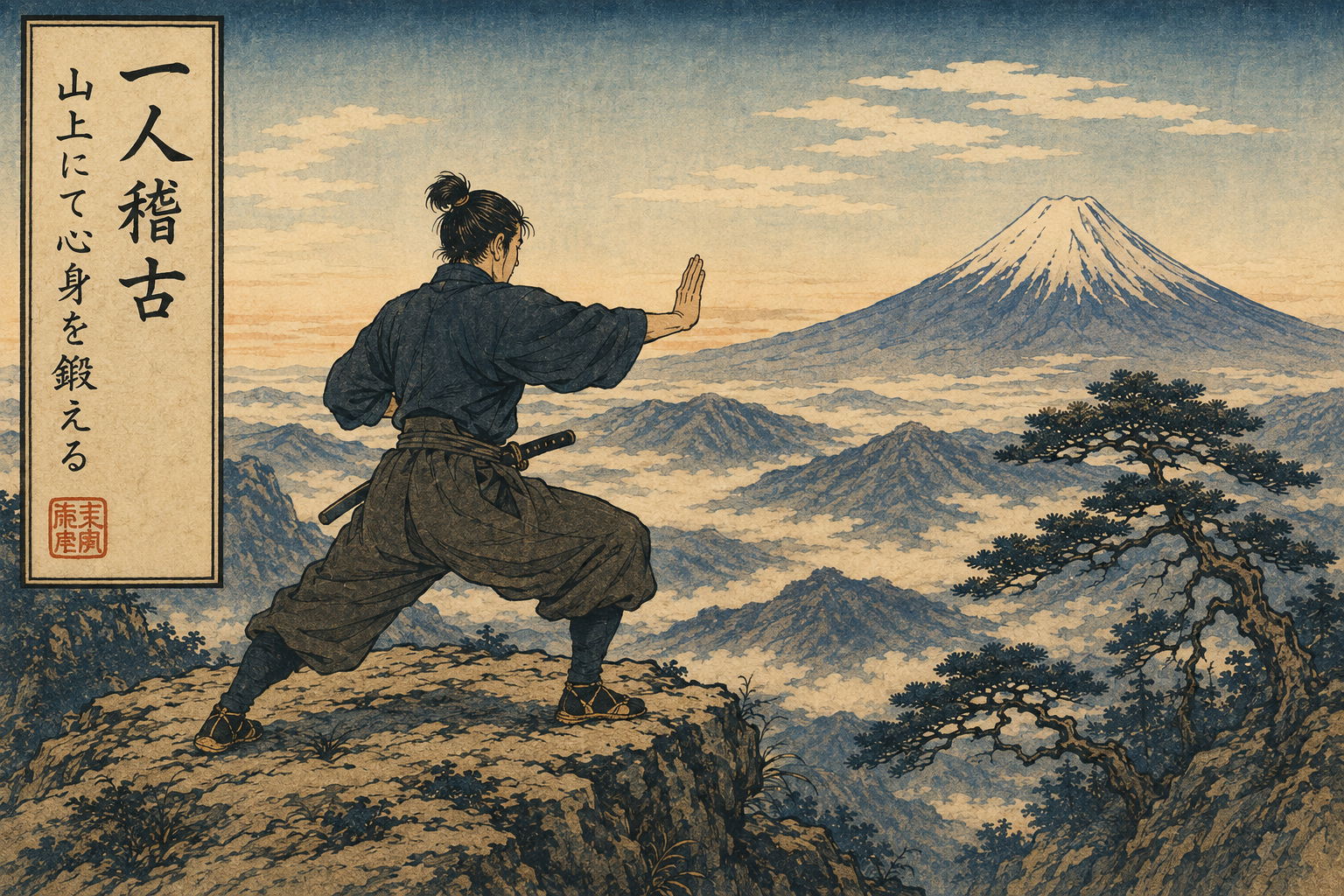
A useful Japanese term here is hitori geiko (一人稽古), meaning individual or solo practice. It isn’t a replacement for training with a qualified instructor. It is what we do between those opportunities.
The Ninja Training TV curriculum already gives us plenty to work on alone: kamae, tai sabaki, ukemi, kaiten, striking mechanics, Sanshin no Kata, weapons fundamentals, and zanshin. The purpose isn’t to become our own Sensei; it is to work on what Sensei has already given us.
Learn Together. Study Alone.
In a piece titled “Think By Yourself,” attributed to Hatsumi Sōke and reproduced by Bujinkan Tasmania, he writes:
After learning skills from his teacher, he trained himself to master those lessons.”
That captures hitori geiko well. Train with your teacher. Pay attention. Practice what you were shown. Discover where you’re stiff, off balance, uncertain, or simply don’t remember, then bring those questions back.
Instruction → Practice → Questions → Correction → Practice
Where Ninja Training TV Fits
This is where remote training through Ninja Training TV becomes especially useful. Training physically alone doesn’t mean training without guidance. We can return to Shihan Roemke’s instruction, study a movement again, practice it slowly, and compare what we’re doing with what was taught. A screen can’t give us real maai (間合い), combative distance, or an unpredictable training partner, but it can give our solo practice direction.
Watch. Practice. Notice. Return. Practice again.
Start With Jūnan Taisō
Before kamae, Sanshin, striking, or weapons, begin with jūnan taisō, your conditioning and flexibility work.
Hatsumi Sōke writes that jūnan taisō has:
much greater significance than mere ‘warm-ups’ for fighting practice”
Masaaki Hatsumi, Ninjutsu: History and Tradition
The point is larger than simply getting loose before class. Jūnan taisō develops suppleness, joint mobility, breathing, responsiveness, and awareness of the body’s condition. For solo training, that’s an ideal place to begin. Pay attention to the hips, ankles, spine, shoulders, and wrists. Notice unnecessary tension. Notice your breathing. Notice whether one side moves differently from the other.
As Hatsumi Sōke also writes:
The body knows how to move if we let it.”
Masaaki Hatsumi, Ninjutsu: History and Tradition
Maintain good form and avoid overexertion. Mobility training should develop the body, not become a contest with it.
A Simple Hitori Geiko Progression
1. Kamae: Find Your Structure
The NTTV curriculum begins with kamae and emphasizes understanding proper posture. Don’t just stand in Ichimonji. Enter it. Leave it. Turn. Change direction. Transition into another kamae. Ask whether your balance and structure survive the movement.
Kamae should be alive.
2. Tai Sabaki: Get Off the Line
NTTV introduces 45-degree evasion early in the curriculum. This is excellent solo material. Imagine a clear line of attack and move your body off it while maintaining balance and kamae.
Shihan Roemke demonstrates this idea in the solo angling drill below.
As you practice, ask:
Did my head actually leave the line? Am I balanced? Could I move again immediately? Simple questions like these can occupy an entire training session.
3. Sanshin no Kata: Return to the Source
Sanshin may be one of our best tools for hitori geiko because it gives us an established framework for studying posture, stepping, angling, receiving, striking, and natural movement. The NTTV curriculum introduces Chi, Sui, Ka, Fū, and Kū early in training. Sanshin isn’t something we finish, it’s something we keep returning to. Sometimes you don’t need a new kata, you need another look at Chi.
4. Ukemi and Kaiten: Work With the Ground
Forward, backward, and sideways ukemi, along with several forms of kaiten, also appear early in the NTTV curriculum.
Use an appropriate surface. Stay within movements you’ve already been taught. Work on smoothness before speed.
5. Striking: Study Alignment
Solo training is a good opportunity to slow striking down. Instead of trying to hit harder or faster, look at the mechanics. Are your shoulders rising? Is your wrist aligned? Is the arm doing all the work, or is the body moving as one unit? What happens to your kamae afterward? Ten careful repetitions may teach more than a hundred rushed ones.
6. Weapons: Extend the Taijutsu
Solo practice can extend into weapons training as well.
The goal isn’t to imagine an elaborate fight. It is to study how the presence of a weapon affects your taijutsu.
Shihan Roemke gives an example with this solo knife training drill:
As you work, notice:
Does your kamae change? Do your shoulders tense? Does your footwork still work? Can you maintain the same angling and natural movement? In that sense, the weapon becomes another way to test the body.
7. Zanshin: Stay Aware
Outdoor solo training gives us another opportunity: zanshin, continuing awareness. Don’t become so absorbed in an imaginary opponent that you stop noticing the real world.
Listen. Notice people, dogs, bicycles, uneven ground, tree roots, wet grass, wind, and changes in footing.
Ninjutsu training shouldn’t make us less aware because we’re concentrating on technique. It should make us more aware.
What Solo Training Cannot Give You
Your imaginary uke always attacks at the speed you expected. He has the reach you expected, never resists, and never changes his timing.
Real training partners ruin all of that. That’s why qualified instruction and partner training remain essential.
Throws need another person’s weight and balance. Joint locks require tactile sensitivity. Timing requires someone whose timing isn’t yours. Maai requires another body. Hitori geiko cannot reproduce those things because it isn’t supposed to. It helps prepare us to get more from them when we return to the dojo.
When Sensei Isn’t There, Keep Training
So today’s park class was canceled. That’s disappointing, but it doesn’t have to be a lost training day.
I can work through jūnan taisō. Move through kamae. Study the angles in Shihan Roemke’s solo drill. Practice Sanshin. Roll. Examine striking mechanics. Pick up a training knife and revisit the solo weapons drill. Pay attention to the world around me.
And with Ninja Training TV, I can return to Sensei’s instruction and give that practice direction.
Train with your teacher when you can.
When you can’t, train what your teacher gave you.
Discover the questions.Then bring those questions back.
That isn’t training instead of Sensei.
That’s continuing the training Sensei started.
And perhaps that is the real value of hitori geiko.
References
Masaaki Hatsumi, Ninjutsu: History and Tradition, discussion of taijutsu and jūnan taisō.
To provide the best experiences, we use technologies like cookies to store and/or access device information. Consenting to these technologies will allow us to process data such as browsing behavior or unique IDs on this site. Not consenting or withdrawing consent, may adversely affect certain features and functions.
Functional
Always active
The technical storage or access is strictly necessary for the legitimate purpose of enabling the use of a specific service explicitly requested by the subscriber or user, or for the sole purpose of carrying out the transmission of a communication over an electronic communications network.
Preferences
The technical storage or access is necessary for the legitimate purpose of storing preferences that are not requested by the subscriber or user.
Statistics
The technical storage or access that is used exclusively for statistical purposes.The technical storage or access that is used exclusively for anonymous statistical purposes. Without a subpoena, voluntary compliance on the part of your Internet Service Provider, or additional records from a third party, information stored or retrieved for this purpose alone cannot usually be used to identify you.
Marketing
The technical storage or access is required to create user profiles to send advertising, or to track the user on a website or across several websites for similar marketing purposes.