The word ninja still captures the imagination like few other martial ideas can. For many people, it brings to mind stealth, mystery, unusual weapons, and secret skills passed down through the centuries. For those who study Bujinkan, the question becomes deeper than fantasy:
Is there really such a thing as a modern-day ninja?
To answer that, it helps to separate legend from tradition, fantasy from training, and image from spirit.
The Roots Beneath the Legend
When most people think of ninja, they imagine a shadowy figure from folklore or film. But the historical roots of ninjutsu point toward something much broader than the popular image. In Ninjutsu: History and Tradition, Dr. Masaaki Hatsumi notes that the ancestors of the ninja lived far from the imperial center, as “naturalists and mystics,” while mainstream society became increasingly rigid, ranked, and tightly controlled. Ninjutsu grew at the edges of power, where survival required adaptability, subtlety, and independence. He describes ninjutsu as having developed as a kind of counterculture to the ruling samurai elite, shaped by concealment, hardship, and survival. This reminds us that historical ninja were not originally thought of as comic-book assassins or mystical super-soldiers. They were people shaped by instability, conflict, geography, and necessity.
Hatsumi writes that in the regions of Iga and Kōka, ninjutsu was refined by many families, each preserving distinct methods, motivations, and ideals. “Ninja” was never just one style or one organization, but a collection of practical traditions shaped by local conditions and generations of experience.
From the Bujinkan perspective, Togakure-ryū is an important historical thread. Togakure-ryū Ninpo Taijutsu is described as the “Hidden Door School,” one of the three ninja traditions in the Bujinkan, and “the strongest basis for modern Bujinkan Budotaijutsu instruction.” Hatsumi traces this tradition back eight centuries to Daisuke Nishina, who, after defeat in battle, fled to the remote region of Iga, took the name Daisuke Togakure, and was credited with founding Togakure-ryū. Those who studied Togakure-ryū were expected to master the 18 forms of Bujutsu, which included everything from Taijutsu to Seishin teki Kyoyo (spiritual refinement).
Historically, the ninja were not just fighters. They were observers, scouts, survivors, and specialists in operating where conditions were uncertain. Their methods included movement, disguise, strategy, environmental awareness, concealment, and endurance as much as direct combat. Later records from the Edo period, such as the Bansenshūkai compiled in 1676, show that ninjutsu eventually came to be written down and systematized as a body of strategy and practical knowledge.
Seen this way, the historical ninja becomes much more interesting than the fantasy version. They were not magical. They were adaptable. This makes them far more relevant to the modern world than legend alone ever could.
Through the Fog of Fantasy
Over time, the ninja became a figure of exaggeration. Legends made them supernatural. Modern entertainment often turns them into assassins, mercenaries, or agents of darkness. That image is powerful, but it is not the heart of ninpo. Hatsumi states clearly in the preface to Ninjutsu: History and Tradition, “I believe that ninpo, the higher order of ninjutsu, should be offered to the world as a guiding influence for all martial artists.”
That is not the language of criminality or theatrical violence. It is the language of moral and spiritual refinement. He goes further and writes, “The attainment of this enlightenment is characterized by the development of the jihi no kokoro, or ‘benevolent heart.’” This may be one of the most important ideas in the entire discussion, because it directly challenges the modern myth of the ninja as a cold, ruthless destroyer. In Hatsumi’s presentation, real ninpo is inseparable from responsibility, compassion, and universal justice. This is one place where many modern misunderstandings can be corrected. The deeper tradition does include stealth, strategy, and unusual methods, but it does not celebrate cruelty for its own sake. The ethical center matters.
Ancient Principles in a Modern World
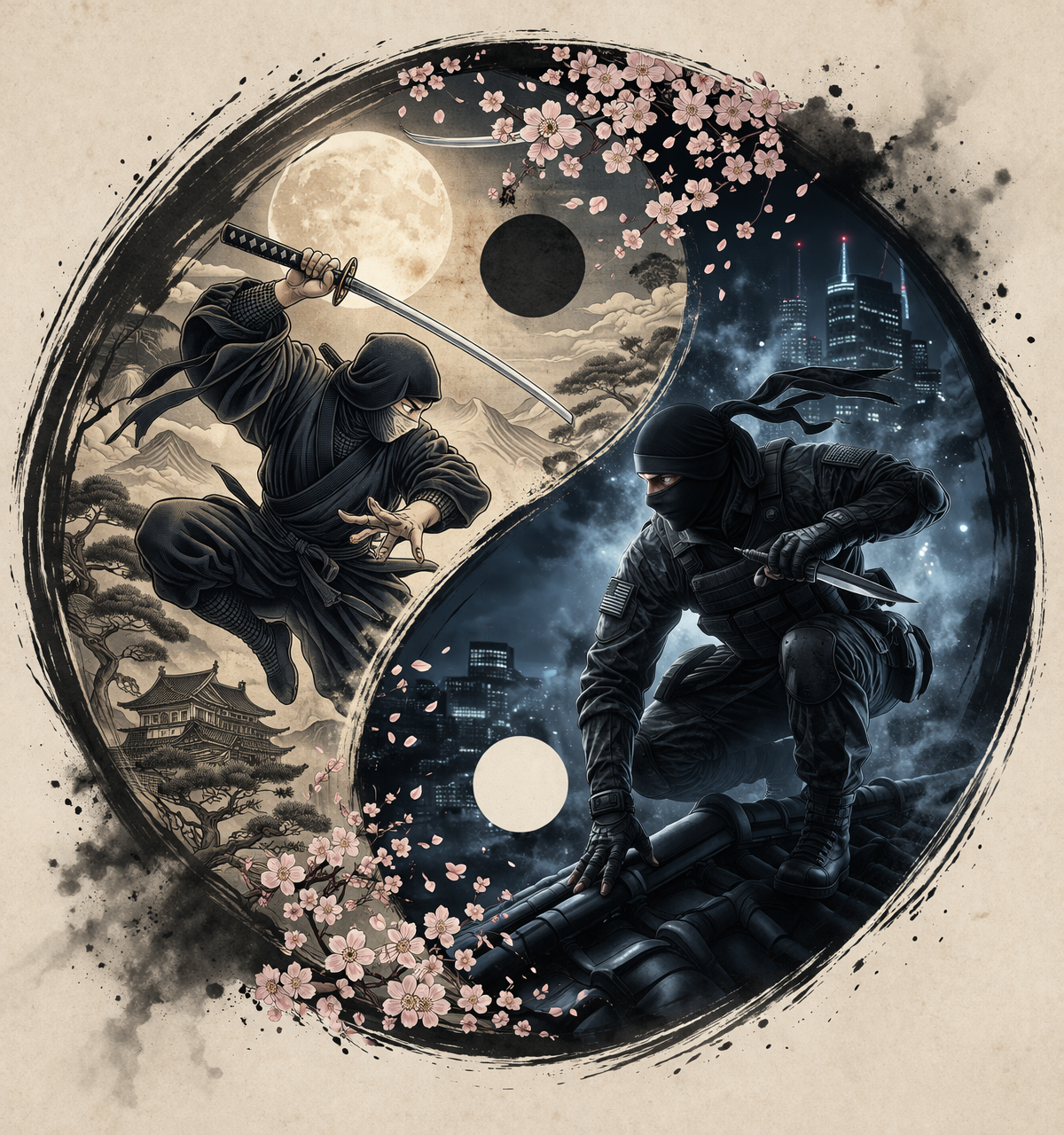
So what might a modern-day ninja look like now? Probably not someone dressed for a movie scene. A modern-day ninja is better understood as someone who embodies timeless principles in a modern world: awareness, composure, adaptability, perseverance, and the ability to move effectively through uncertainty.
This is why the modern Bujinkan practitioner may sometimes see reflections of ninjutsu principles in military, protective, or survival-oriented environments. Skills such as controlling distance, staying aware, using terrain, reading intent, and operating under stress still matter.
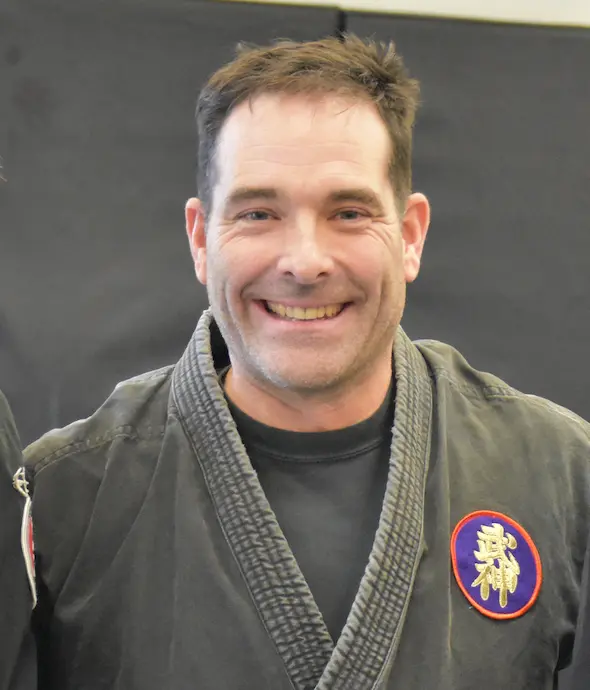
Sensei Roemke’s service in the U.S. Army’s 10th Mountain Division, together with decades of Bujinkan training and teaching, helps show how traditional principles can still be recognized in demanding modern environments. The connection is not that “soldier equals ninja,” but that enduring principles such as awareness, mobility, discipline, and adaptability remain relevant across time. This principle-based approach is reflected in some of Sensei Roemke’s firearms training material, where modern tools may change, but the underlying principles of survival and adaptability remain familiar.
Shidoshi Jack Hoban offers another meaningful example of this bridge between classical principles and modern application. As a former U.S. Marine Corps captain, longtime Bujinkan practitioner, and contributor to the Marine Corps Martial Arts Program, he is often cited as someone whose life reflects the meeting point of traditional budo and real-world service. His example supports a mature point that traditional martial principles do not become irrelevant because the century changes.
The Spirit That Endures
In the end, the most important question is not whether someone today resembles the old legends. The real question is this:
What is the spirit behind the training?
For that, one of the strongest lines preserved in the tradition is this: “The way of the ninja is the way of enduring, surviving, and prevailing over all that would destroy one.” That line gives us a far better picture of the modern-day ninja than any costume ever could.
The true ninja spirit is not about looking mysterious or acting dangerous. It is about perseverance and loyalty to what is right. It is about remaining calm when others panic. It is about cultivating awareness instead of carelessness, restraint instead of recklessness, and courage instead of ego.
A person living with that spirit may simply be a martial artist, a parent, a soldier, a teacher, or an ordinary person who has learned to move through adversity with clarity and heart. That is why the idea of a modern-day ninja still matters. Not because we need more fantasy, but because we still need human beings who can endure hardship, think clearly, act skillfully, and protect what matters without losing their humanity.
In that sense, the modern-day ninja is not a relic of history. They are a living possibility. Perhaps that is the deepest lesson of ninpo: not how to become a myth, but how to become fully present, capable, and compassionate in a difficult world.