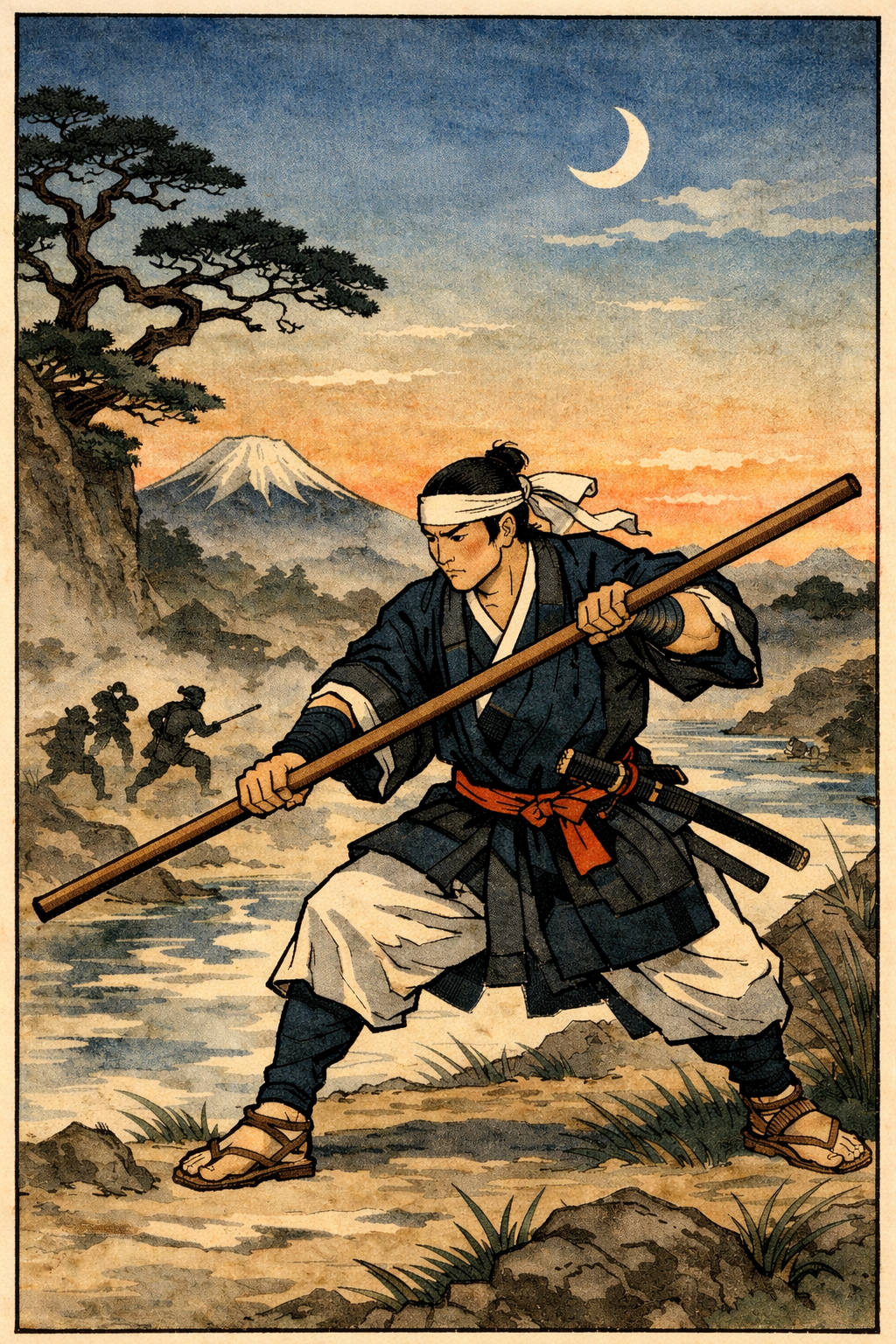
A rokushaku bō is six feet of wood… and a mirror.
It doesn’t care what you meant to do. It shows what you actually did… where your posture leaks, where your timing hesitates, where your attention drifts. A lot of people pick up a staff and immediately reach for the flashy stuff: big spins, big sweeps, big “ninja energy.” But good bō training is quieter than that. It’s less about looking impressive and more about owning space.
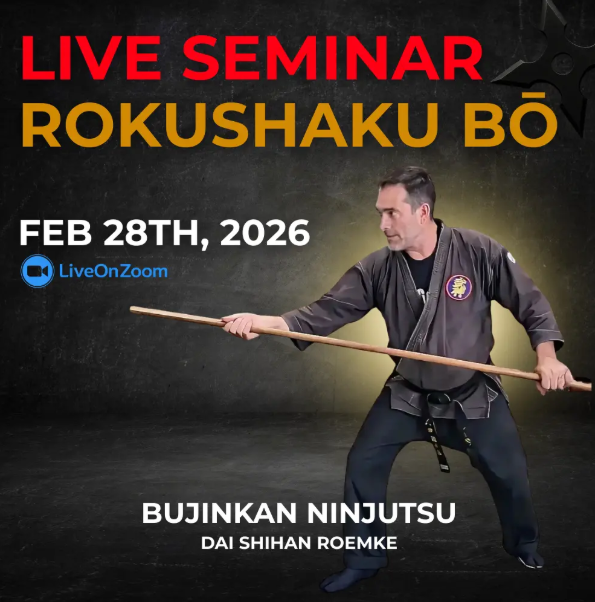
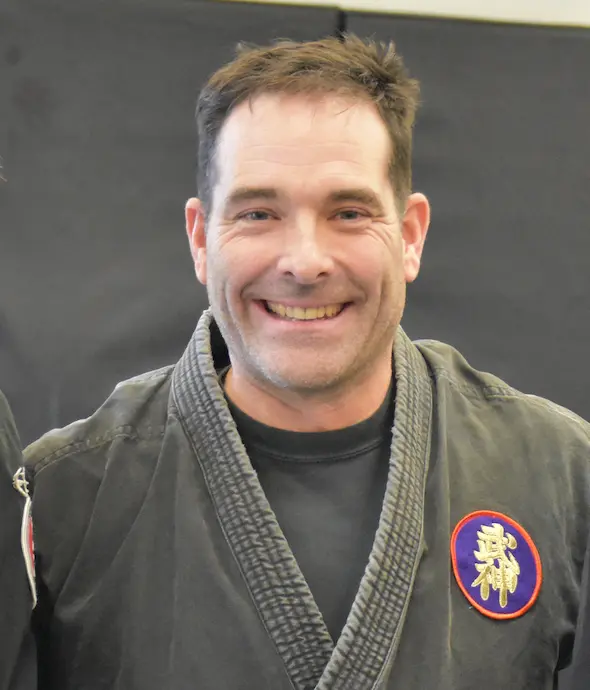
That’s why I’m excited for Dai Shihan Mark Roemke’s Rokushaku Bō Seminar (NTTV) on Saturday, February 28, 2026. It’s a chance to take the staff out of the corner and put it back where it belongs: in your hands, with intention.
Reserve your spot: https://ninjatrainingtv.com/product/rokushaku-bo-seminar/
What’s a “shaku”?
A shaku (尺) is a traditional Japanese unit of length. Like many old measures, it carries a “human body” origin story, using hand-span / forearm-style references, so the spirit of the measure feels personal. In Japan, shaku was later standardized, so “roku-shaku” (“six shaku”) became a consistent category of length, which is why “rokushaku bō” is generally treated as “a six-foot staff”.
Even with a standardized unit, the staff still has to fit the wielder. Body size, mobility, and intent change how a bō handles. Many practitioners choose (or customize) a length that preserves the same relationship between posture and weapon, keeping the old “body-measure” spirit alive in modern training.
The ordinary stick, and the extraordinary person
The bō is just wood, and that’s its gift. No tricks, no shortcuts. It simply reflects what you bring to training, over and over, until you change.
Hatsumi Sōke says it better than anyone:
“Even if someone appears unintelligent and with no social standing, if they are consistent and persevere, they have the potential to one day become great. If you are able to fully master an ordinary stick through training, then even as an ordinary person you can become extraordinary. This is one of the esteemed qualities of Bō-jutsu.”
– Masaaki Hatsumi, Advanced Stick Fighting
Ordinary stick. Ordinary person. Extraordinary training.
Where the rokushaku bō lives in the Bujinkan
If you trace where bōjutsu shows up across the Bujinkan lineages, you’ll see it in multiple streams (including Togakure Ryū, Kukishinden Ryū, and Takagi Yoshin Ryū). For this seminar and this blog, we’re keeping our feet on the main road. We’ll talk some basics with a focus on Kukishinden Ryū.
The bō makes things honest: distance, timing, posture, and intent. It’s hard to hide behind small mistakes when you’re holding six feet of leverage.
And that “bigger-than-technique” feeling is something Dai Shihan Arnaud Cousergue articulated beautifully. When Hatsumi Sōke spoke of rokushaku bōjutsu, many people only heard “the size of the weapon.” But for training, it points deeper, toward shiki (識): consciousness. Train the weapon on the outside (omote), and something inside (ura) begins to wake up.
The shape of readiness: kamae
Before you worry about “technique,” let your eye learn the shapes. Kamae are ready states that organize posture, distance, and intention. And they’re not always something you “hold.” Often kamae are transitory, a shape you pass through during a technique, shifting as the moment changes. The point is having solid structure at any point in time.
In this video short from NTTV, Sensei Roemke flows through the rokushaku bō kamae.
Below are the rokushakubō kamae, shown by Dai Shihan Mark Roemke.
Hira no Kamae (Flat Posture)
Structure: Square your base, soften the knees, and keep the spine tall. Keep the bō “flat” through the centerline so your shoulders stay down and your elbows stay connected.
Feeling: Wide, quiet, and ready, like still water that can move instantly.
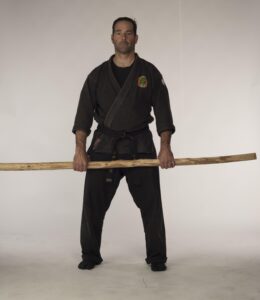
Hira Ichimonji no Kamae (Flat Ichimonji)
Structure: Blade the body without leaning, front shoulder relaxed, hips angled, and weight centered. Keep the bō on a flat line that stays connected to your frame (elbows in, spine tall).
Feeling: Quiet edge, like standing behind a door that’s already half open.

Chūdan no Kamae (Middle Level)
Structure: Set a neutral, balanced base with soft knees and a tall spine. Present the bō through your centerline at mid-level, keeping shoulders down and elbows connected so the weapon moves with the body, not just the hands.
Feeling: Calm, direct, and ready to become anything. Many Kukishinden Ryū waza begin here.

Seigan no Kamae (Correct Eye)
Structure: Build a stable base with a tall spine and relaxed shoulders. Align the bō so the tip settles on the opponent’s eye line (not high, not low) while keeping elbows connected so the line is supported by your body, not arm tension.
Feeling: Quiet precision, like your awareness is already there before the strike is.

Jōdan no Kamae (Upper Level)
Structure: Keep a grounded base with soft knees and a tall spine. Don’t get onto the toes or arch the back. Raise the bō to an upper line while keeping the shoulders heavy and the elbows connected, so the weapon is supported by your body structure instead of arm tension.
Feeling: A drawn thundercloud, power gathered overhead, but the mind stays calm and unreadable.
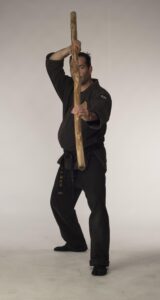
Ihen no Kamae (Changing Posture)
Structure: Set a stable base and angle the bō downward so incoming force is guided off-line rather than absorbed straight into you. With the forward hand, you can support the bō with the fingers or forearm without fully wrapping. This helps protect the fingers when a strike is deflected.
Feeling: Like turning your body into a slope… energy arrives, meets an angle, and slides away.
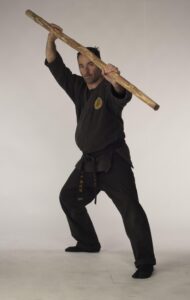
Ura Gedan no Kamae (Lower Level)
Structure: Drop the line low with a stable base and a tall spine. Low doesn’t mean collapsed. Keep the bō close enough to your frame that your body can conceal its full length, reducing what the opponent can read while still keeping the weapon ready to rise or redirect.
Feeling: Quiet misdirection. What they think they see is shorter than what you can reach.

Heitō no Kamae (Overthrow Evil Posture)
Structure: Set a firm base and keep the spine tall while you draw the bō into a strong, angled line through your frame. The key is “connected power”: shoulders relaxed, elbows alive, and the weapon supported by hips and posture, not arm tension.
Feeling: Like winding a spring… tension gathered and contained, ready to release without losing control.

Tenchijin no Kamae (Heaven / Earth / Man)
Structure: Root the stance without sinking, knees soft, hips level, spine tall. Set the bō so your frame feels like one connected column: feet grounded, hands responsive, shoulders relaxed, and the weapon supported by whole-body alignment rather than isolated arm strength.
Feeling: Gather from below, settle from above. Earth rises into your legs, heaven pours down through your crown, and you become the bridge. Quiet center, steady breath, and a line that feels bigger than muscle.
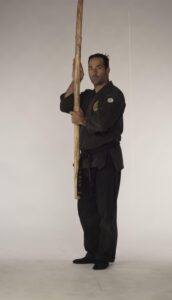
Reihō (礼法) — Three ways to begin (and end) with the Rokushakubō
Before technique comes reihō (礼法), the ritual of beginning. In Japanese martial arts, reihō is the moment you set the mind straight: respect for the teacher, the partner, the weapon, and the space you’re about to move through. It’s a reset of posture, awareness, and attitude: omote (表) (outer form) shaping ura (裏) (inner mind).
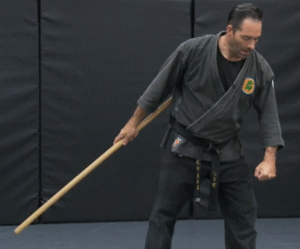
Reihō 1 — Standing bow (ready state)
Let the bō settle to about a 45-degree angle across your back, step forward with the left foot, and keep the left hand in a fist in front of you.
This one feels like: “I enter practice awake.”
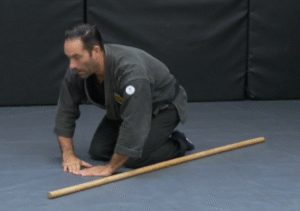
Reihō 2 — Kneeling acknowledgment (one knee)
Put the bō at about a 45-degree angle across your back, drop down to your left knee, and place your left hand on the ground.
This one feels like: “I lower myself without collapsing.”

Reihō 3 — Seiza bow (both knees)
Get down on both knees, place the bō on the ground on your left side, and bow with both hands on the floor in front of you.
This one feels like: “I return to stillness.”
Straight lines, clear target: striking
The rokushaku bō teaches striking in straight lines and clear targets because the weapon amplifies structure. When your posture is aligned, the bō delivers power cleanly; when it isn’t, the mistake shows up immediately. Here are the foundational strikes we train with the rokushaku bō:
- Shōmen Uchi (strike to the crown)
- Yokomen Uchi (strike to the temples)
- Dō/Kote Uchi (strike to the body / wrist)
- Age Uchi (rising strike)
- Ashi Barai (leg sweep)
- Tsuki (thrust)
This NTTV clip covers foundational striking ideas and how to build clean mechanics from the basics.
Staff striking basics:
Circles with purpose: spinning
Spinning is where people get hypnotized because it looks impressive. But functional bō spinning isn’t a magic trick, it is mechanics and control: clean line changes, smooth transitions, and the ability to stop instantly without losing posture.
Mechanics
A good spin is powered by structure, not flailing arms. The hands stay “alive” (not death-gripping), the shoulders stay down, and the bō stays connected to your frame so you can change direction without wobble. The spin should not put you off balance.
Control
Spinning expands the weapon’s reach fast. Give yourself room… walls, lights, ceiling fans, windows, and training partners all disappear quickly when momentum takes over. Start slow, and treat “braking on command” as the first skill. If you can’t stop cleanly, you’re going too fast.
Misdirection
Done well, spinning can create misdirection, not by being flashy, but by hiding resets. A small, controlled rotation can mask a grip adjustment, change the line, or shift the angle so the opponent reads one thing while you’re already becoming another. The goal isn’t to mesmerize them It’s to remove your tells.
Spinning is how you learn to move like space itself… continuous, unbroken, and hard to pin down. A circle has no corners to grab.
The basic spins in the Bujinkan
- Forward Spin
- Backward Spin
- Side-to-Side Spin
- Changing from One Spin into Another
- Bō Furi Gata (2 people striking with bō)
This NTTV short is a great teaser… and it’s also a perfect reason to attend the seminar if you want the deeper mechanics, corrections, and partner timing in real time.
Think “small circles, strong brakes”… control first, speed later.
Medium-risk reminder: spins add speed and range quickly. Train slowly, give yourself space, and don’t do close-range partner work unless you have supervision and clear communication.
Zoom seminar prep: set yourself up to succeed (Indoor / Outdoor)
You don’t need a perfect setup, just a safe one. The bō is long, and it doesn’t care how expensive your lamp was.
Option A: Train indoors
Space
- Clear a lane at least 8–10 feet long, plus a few feet side-to-side.
- Make a “no-go zone” around TVs, windows, shelves, ceiling fans, hanging lights, and anything fragile.
Footing
- Watch rugs, hardwood, and slick socks. Choose traction over style.
Camera
- Set the camera far enough back to catch full body + as much of the bō as possible.
- A slight front-corner angle usually shows footwork and lines best.
Option B: Train outdoors
If you’ve got a tablet, this is a great way to protect the furniture and get real space.
Space & footing
- Yard, driveway, garage, or a quiet park corner, anywhere you can swing safely.
- Watch gravel, wet grass, leaves, hidden holes. If you’re on a driveway, set a boundary away from cars and windows.
Overhead check
- Look up: branches, wires, eaves, basketball hoops—anything your bō could tag on an upswing.
Weather & sound
- Wind and bright sun can make it harder to hear cues and see details.
- If it’s gusty, slow everything down and prioritize control.
Tool choice
- Full-length bō is ideal, but if your space is tight, start with a shorter staff (or safe substitute) for mechanics, then transfer back to full length when you can.
Safety rule that fixes almost everything
If you can’t stop the bō instantly, calmly, without wobbling, then slow down.
Control first. Speed later.
The Gate of the Plain Stick
The bō is plain wood.
That is its secret.
It rewards consistency.
It rewards perseverance.
And it asks for a mind that can stay awake without shouting.
Train the outer form until it disappears.
Then what remains is not “technique,” but presence…
and presence is the most ninja thing of all.
Six feet of intention.
One step into the space between.
Reserve Your Spot — Rokushaku Bō Seminar: https://ninjatrainingtv.com/product/rokushaku-bo-seminar/