
At a recent training session in the park, we ended up going deep into Sanshin no Kata. Sanshin is one of those things you can “know” for years, but it still keeps teaching you. In Bujinkan Budō Taijutsu, Sanshin no Kata is a foundational method of movement from Gyokko Ryū, commonly expressed through five elemental forms: Chi (Earth), Sui (Water), Ka (Fire), Fū (Wind), and Kū (Void). These aren’t meant as mystical ideas. They’re a way to train the body using posture, stepping, angling, striking, balance, and timing, which you build until good movement shows up naturally.
Hatsumi Sōke also points to the deeper purpose of this practice. In Unarmed Fighting Techniques of the Samurai, he connects Sanshin to shin-gi-tai (mind–technique–body):
The Source of Sanshin
Sanshin no Kata is associated with Gyokko Ryū, a tradition known for kosshijutsu principles including angling, structure, and striking method that influences much of our taijutsu. In our training culture, it’s often said that if you keep refining Sanshin and the Kihon Happō, you keep refining everything. For more information on Gyokko Ryū, see our earlier blog.
The reason it survives is simple: the movements are fundamental. They’re not “special tricks.” They’re lessons in how to move, whether you’re unarmed or armed.
The Five Forms
The descriptions below assume you start from shizen no kamae (自然の構). There are traditional variations that begin from other kamae, and you’ll meet those as you progress. Each kata takes you off-line from the attack, perform uke-nagashi (receiving and redirecting an incoming strike), and then an attack.
Sensei Roemke demonstrates the Sanshin in this video:
Chi no Kata (地の型) — “Standing your ground”
Chi is the baseline. It’s where you learn to evade and return without losing your balance or structure.
Feeling
- Calm, grounded, quiet
- “Glide” out, then “glide” back in
Basic outline (from shizen)
- Move offline at a 45° angle
- Put your defensive arm up to block any incoming attack
- Swing your other arm up, like you are bowling. You use a sanshitan ken (three-finger fist) to strike.
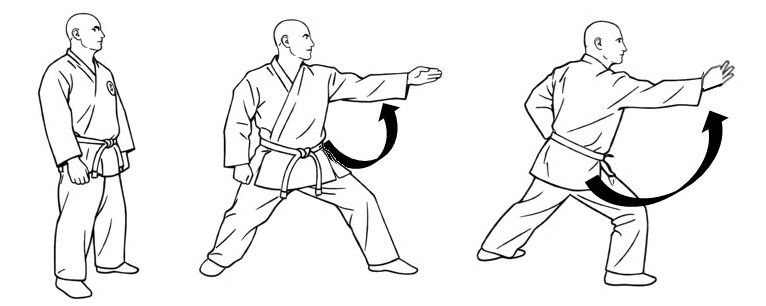
Sui no Kata (水の型) — “Flow like the ocean”
Hatsumi Sōke has also called this mizu no kata. This kata feels best as a flow through the moves.
Feeling
- Like a wave: away… then back in
- Timing of hands and feet together
- You don’t “block,” you receive and enter
Basic outline (from shizen)
- Move offline at a 45° angle
- As your body shifts, bring the front arm up into a jodan uke to block an incoming strike.
- Walk in with structure and strike with omote shutō (表手刀).
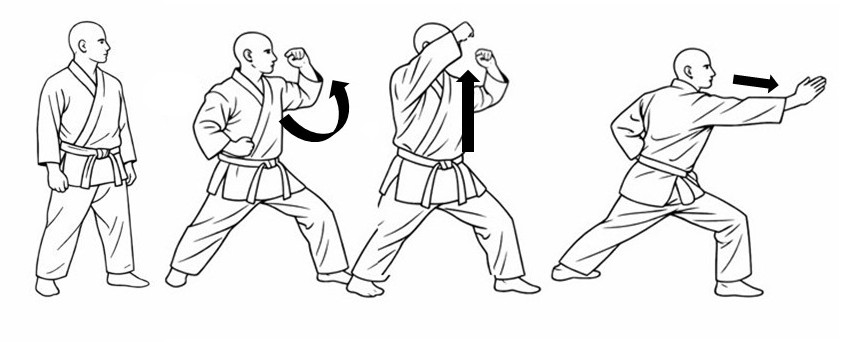
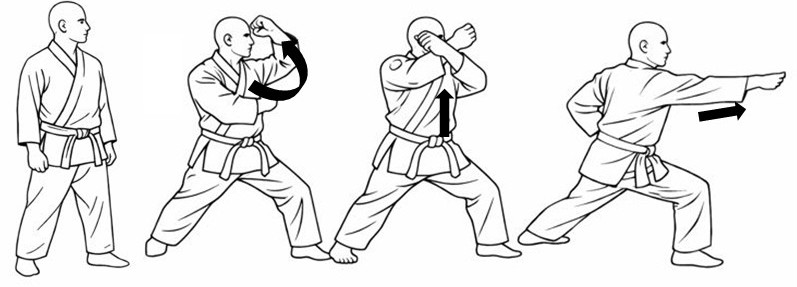
Ka no Kata (火の型) — “Flicker like a flame”
Hatsumi Sōke has also called this hi no kata. Ka often highlights the guard of jumonji to protect your center while entering with intention.
Feeling
- Sharper and more direct than Sui
- Protected entry
- You “cut through” the space rather than circling
Basic outline (from shizen)
- Move offline at a 45° angle
- As your body shifts, bring the front arm up into a jodan uke to block an incoming strike.
- Shift into a jumonji stance.
- Step in and strike with ura shutō (裏手刀).
Fū no Kata (風の型) — “Move like the wind”
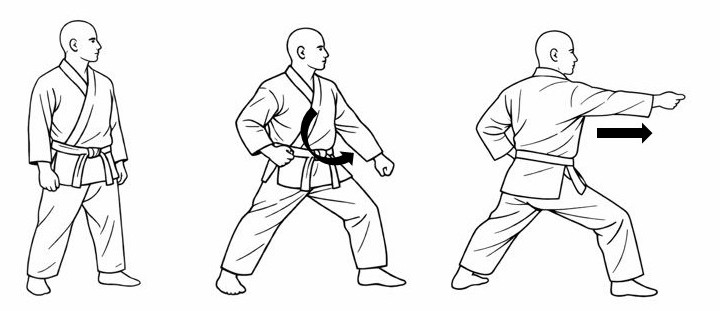
Hatsumi Sōke also uses kaze no kata to describe this. Fū changes the level, bringing in a lower receiving motion and a different kind of counterstrike. Often the feel if you are late to defending.
Feeling
- Light and quick, but not rushed
- A low receive that opens the line
Basic outline (from shizen)
- Move offline at a 45° angle
- As you shift, bring the arm down into gedan uke (a low block).
- Step in and strike with boshi ken (拇指拳) to an appropriate target based on distance and opening.
Kū no Kata (空の型) — “Pay no attention to what I’m doing”
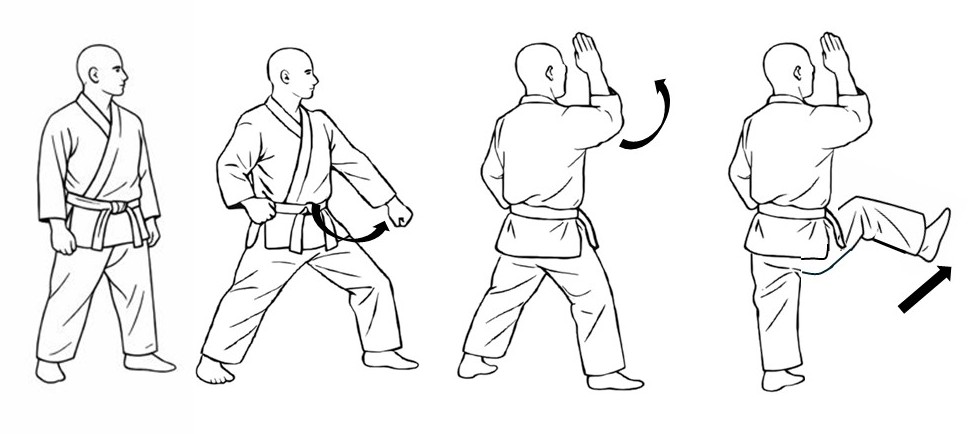
Kū is often described as “everything—or nothing.” Distraction is the name of the game for this kata. Traditionally, the metsubushi (目潰し) is raised as a distraction, but another way to play with it is to look at your distracting hand while you perform the kata, which emphasizes the idea that you are moving without giving away your intention.
Feeling
- Seamless transitions
- Disruption and misdirection
Basic outline (from shizen)
- Move offline at a 45° angle.
- Block with your arm down into gedan uke, while disrupting the opponent’s attention with your other arm with a metsubushi.
- Kick with a zenpo geri.
Sanshin With Weapons: Same Format, New Tool
One thing Sensei Roemke emphasizes is that Sanshin isn’t just an empty-hand drill. It’s a movement template. Once you understand that, weapons training stops feeling like a separate subject and starts feeling like the same body method wearing different clothes.
So instead of thinking, “Now I’m doing sword,” or “Now I’m doing hanbō,” the mindset becomes:
“I’m doing Sanshin… and the weapon is how it shows up today.”
That’s why Sanshin works across the board:
- sticks (hanbō, jō, rokushakubō)
- swords (bokken/shinken training appropriate to level and safety)
- flexible weapons (kusari, rope, belt, etc.)
- modern tools like firearms in the sense of movement, posture, distance, angling, and calm handling under pressure.
The practice stays consistent:
- Chi: structure and grounding (bones, posture, stable delivery)
- Sui: receiving and flow (timing that carries you in)
- Ka: protected entry (pressure forward with your center guarded)
- Fū: angle change (lightness, shifting line)
- Kū: misdirection and disruption (kyojitsu, stealing attention, entering “unseen”)
In this video, Sensei Roemke shows some examples of using sanshin no kata with weapons:
Train with the Sanshin
One useful way to keep Sanshin alive is to train it through layers: Shoshin → Gogyo → Goshin.
Shoshin (初心) — Beginner’s Mind
At the Shoshin level, you practice the five forms solo, like moving study against an imagined opponent. This is the “wiring” stage: coordination, posture, and natural movement.
Shoshin also means something deeper: an open mind. The same movement can reveal different lessons depending on what you pay attention to. In my own training I’ve been focusing a lot on hip movement and how power is built into the step and weight shift. But that’s just one lens.
Different teachers often emphasize different things at different times. One teacher may show a feeling of almost falling forward. Another emphasizes arm swing as natural momentum. Another focuses on weight shift and angle. The core form stays the same, but the lesson changes, because Sanshin is big enough to hold all of it.
Gogyo (五行) — Applying the Elements
When the five movements are trained as Gogyo no Kata, they’re practiced against a partner. This is where theory meets reality: timing, distance, height differences, reach, angles, and the unpredictability of an actual attack.
The goal isn’t to reinvent the kata. It’s to make minimal adjustments while keeping the core movement intact, refining the base mechanics and learning how to adapt without losing structure.
Goshin (悟心) — Wisdom Mind
At the Goshin level, Sanshin starts to feel less like “five separate forms” and more like a single moving study. The shape is still there, but the goal changes. You’re not trying to think your way through it anymore, you’re trying to let the body move without forcing.
In that sense, it can become a kind of moving meditation. Not mystical, just quiet. You repeat the same thing until the mind stops grabbing the steering wheel, and you notice what’s actually happening: balance, timing, posture, breath, tension, and the little habits that sneak in when you’re not paying attention.
That’s why it never really ends. The forms are simple on purpose. You can practice them anywhere… dojo, park, living room… and they’ll still teach you if you let them.
If you’re feeling stuck, don’t go hunting for “new techniques.” Come back to Sanshin. Pick one element and train it slowly for a week. Let it clean up your stepping, calm your shoulders, and sharpen your distance.
Simple forms. Endless study. Keep training… because the basics will carry you farther than you think.