
In the world of Bujinkan Budo Taijutsu, certain concepts act as hidden hinges, small details that support the entire structure. One of those concepts is Kaname (要).
Kaname means “the vital point” or “crux.” It is the bolt in the hinge, the pin in the structure, the detail that if removed, causes everything else to fall apart. In movement, in kamae, in structure, in perception, there is always a kaname.
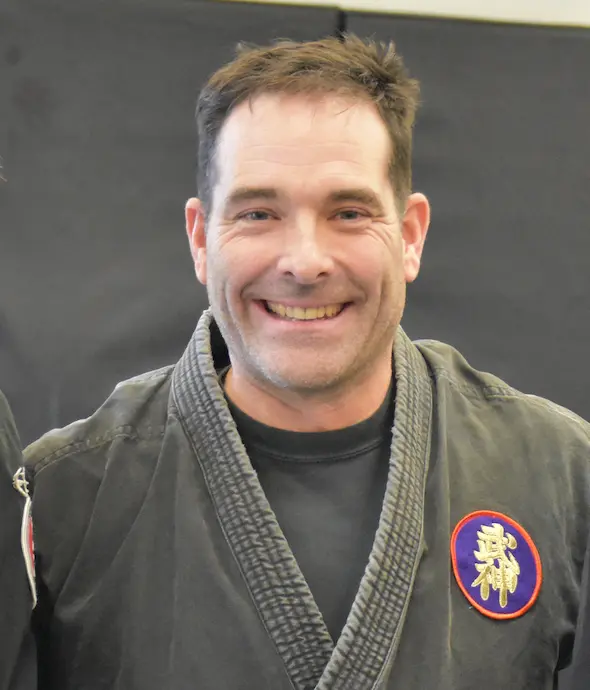
Dai Shihan Rob Renner highlighted this concept in his 2012 article “Kaname,” and further expanded on it during a seminar hosted by NTTV’s own Mark Roemke. What follows is a distillation of that teaching.
The Three Core Kaname
1. Maai no Kaname – The Essence of Distance (間合いの要)
Maai isn’t just about space. It’s about perceptual timing. The kaname of distance is when your attacker believes they can reach you, but in truth, they cannot… and you can reach them. That razor-thin margin is often referred to as kami hitoe (a hair’s breadth).
“To be at this distance — where you can cut your opponent to the bone, while he merely cuts your flesh — you must be right on the edge, which is to say close enough to be cut!” — Rob Renner
This is not a concept you understand in theory. You feel it in randori and honed through repetition. Bujinkan footwork drills and angling exercises are built to train this distance recognition.
2. Kukan no Kaname – The Essence of Space (空間の要)
Kukan (space) is shaped by movement over time. Think of it as the “geometry of danger.” It’s the arc of a sword before it hits, the structural weakness of an opponent mid-strike, the moment when you reposition and break their ability to generate power.
One way to explore this is through body alignment drills: adjust an opponent’s shoulder or hip just slightly, and their ability to deliver force collapses. That, too, is kaname.
3. Ugoki no Kaname – The Essence of Movement (動きの要)
Most of us telegraph. Even experienced martial artists unconsciously shift weight before they move. But taijutsu at a high level becomes imperceptible. There is no “tell.”
A training drill Rob suggested: stand in front of a mirror, feet together. Try stepping forward without any preliminary shift. The habitual prep movement reveals itself instantly. Training to eliminate that is the kaname of ugoki.
The Nine Kaname
Sensei Renner shared a structured approach to these ideas during the seminar hosted by Sensei Roemke. While his language and teaching methods have evolved, these nine principles still offer a useful lens for refining your movement with diagnostic clarity:
- Kamae – Head, shoulders, hips, and feet aligned. Mobile and stable.
- Ugoki – Down and over, with minimal movement. No telegraphing.
- Kyori – Distance manipulation (see Maai).
- Hyoshi – Timing. Feet move slightly before, hands slightly after.
- Totoku – Shielding. Forearm acts as sword guard.
- Katachi – Structure. Proper contact points for leverage.
- Kuzushi – Breaking balance just enough to take kamae.
- Chikara o Nuku – Press, Pulse, Press. Strategic release of pressure.
- Shiho Dori – The four invisible angles from the zero-point connection.
These are tools of awareness. Use them to observe what’s happening in your own body, in your partner’s posture, and in the shared space between you.
Final Thought
Kaname is not a technique. It’s a way of seeing. Train long enough, and you’ll start noticing how every technique has a hinge point. A fulcrum. A heartbeat. That’s the kaname. When you feel it shift, when your timing, posture, and movement all align in that hair’s breadth of space, that’s when the art flows naturally, without resistance, and becomes almost invisible.
As always, the deeper understanding comes not from reading but from feeling. If you want to go further with these concepts, we encourage you to connect with Rob Renner directly through one of his seminars or training opportunities.
Play, explore, and find the kaname.
Note from the Author: The Nine Kaname shared here were originally introduced by Dai Shihan Rob Renner as a way to help practitioners gain diagnostic clarity in their taijutsu, not as rigid formulas, but as training lenses. These ideas emerged during his earlier work, including seminars such as the one hosted at Sensei Roemke’s dojo.
Since then, Sensei Renner’s understanding and teaching have continued to evolve through his deep immersion in training and life in Japan. He now uses even more refined and practical tools in his teaching. If you’re inspired by the concepts shared here, we strongly encourage you to seek out direct training with him at Zeropoint Dojo or one of his seminars. Nothing replaces the feeling of hands-on guidance.